According to the forum on The Boat That Rocked (Pirate Radio)'s IMDB page there were mixed opinions on the film. Generally, positives included the films soundtrack- although many were annoyed by the absence of The Beatles, a typically iconic 60's British band (due to the fact that Universal did not own the rights to use their music on the soundtrack- Michael Jackson once owned their publishing catalog, but sold large parts of it to Sony to finance his later career and lifestyle. EMI and Apple Corps own nearly all their recordings.) It could have further helped the marketing campaign if the Beatles music was used because of its exclusivity and extreme popularity GLOBALLY, adding to the film's national and international appeal.
Many Americans were angry at the title change, and found it patronising and insulting that Focus Features felt the need to 'dumb it down' for an American audience. This is a popular opinion amongst many online forum users and some movie critics. http://www.imdb.com/title/tt1131729/board/nest/149471627?p=1
United International Pictures (jointly owned by Universal and Paramount) distributed it and marketed it in the UK whereas Focus Features did it in the US. Though they appear to be seperate companies UIP is a global horizontally integrated media conglomerate and Focus Features is actually just an art house division of Universal Pictures. The decision to distribute it through them in America would have marketed the film as a more arty, indie film, attracting a more selective niche audience than the UK. This decision may not have been the right one as it is normally UK audiences that prefer the smaller, more art house films, whereas US audiences tend to prefer big high concept films which you would often associate with large distribution companies such as Universal.
TBTR had a marketing budget of around $30 million, which is actually quite a large amount, although of course nothing compared to Avatar's $200 million plus. This would have greatly impacted on their marketing schemes as they would not have been able to afford as many TV spots etc. and invest in riskier newer, high concept online viral campaigns like AVTR.com- which actually proved pretty unsuccessful due to lack of maintenance and updates because they could afford to develop multiple strategies such as symbiotic campaigns with huge businesses like McDonald's and Coca Cola. Had UIP put all their money into one big risky branch of, for example online or viral marketing, it would have had no choice BUT to be successful as they did not have the luxury to fallback on any of the other marketing strategies due to a limited budget. Their decision to 'play it safe' and produce a tried and tested traditional campaign may have been the less, in business terms, riskier option. However, a cutting edge campaign could have potentially drawn in larger audiences and contributed to a higher gross at the box office. On the other hand it could have completely flopped and the film could have been seen by even fewer people than it was. Ultimately, it was a risk UIP was not willing to take, which is understandable because no-one is able to predict the outcome of a film's success before it is released- only speculate.
The Boat That Rocked World premiere was held at Odeon Leicester Square on the 23rd March 2009.
"A red carpet wound through the middle of London's Leicester Square as women dressed in 60s' outfits danced on a plinth with vinyl record discs in the background. Sir Paul McCartney and his girlfriend Nancy Shevell were also pictured in good spirits on the red carpet. Geri Halliwell also turned heads in a gold mini-dress. Bond Girl Arterton described the film as "fun, fun, fun all the time. It was brilliant". Rhys Ifans, wearing rock star dark glasses and a snakeskin-style jacket, ambled up and down the red carpet Jane Seymour also attended the premiere as did Jonathan Ross with his daughters and son."
Celebrity guests of the premiere were all somehow linked to the music industry, really playing on the whole 'rock and roll' ethos of the film. The 60's style models provided fun photo-ops for all the stars and many of the pictures were funny and racy- completely capturing the light hearted and provocative nature of the film and an effort to secure front page headlines. Photos also later surfaced of star Gemma Arterton looking worse for wear whilst leaving the after party- synonymous with the young care free attitude of the 60's.
Unfortunately, Reality TV star Jade Goody had passed away the previous day (also Mother's Day) so much of the press was dedicated to her. To feature such an upbeat, comedic film alongside the tragic death of a young public figure would have been distasteful. In turn, this meant that the film did not get the coverage the studio would have hoped for.
Headlines from the 24th and 23rd of March
However, in the build up to the world premiere in London, many competitions were run.
Global Radio signed a deal with Cineworld and Universal Pictures to promote the film on its radio stations- a great example of cross media convergence.
On top of this, famous DJ Christian O'Connel broadcast his show on a boat in anticipation of the films release.
The premiere for Avatar took place on the 10th December 2009. For a start, there were no huge headlines to contend with, so coverage of the event was saturated over the entertainment pages of every newspaper. The intense hype around the film created a huge turn out, though the screening itself was EXTREMELY EXCLUSIVE. Fox had embargoed reviews until the 14th so guests and critics were sworn to secrecy, providing even more of a challenge for tabloids to compete to reveal the slightest pieces of information on the film. In contrast to the typical red carpet, the Avatar premiere had a blue carpet in keeping with the predominant colour scheme of the film and brand marketing.
On December 4th, the video for the soundtrack of the film 'I See You' by Leona Lewis was released with the song available to purchase via the motion picture soundtrack on the 15th- during the week of the films global release. The famous BRITISH talent show winners video featured clips from the film. As she was busy promoting her own album in the states, she was not in attendance at the London premiere but sparkled her way to the front pages a few days later at the LA premiere wearing a stunning embellished gown landing her way onto fashion pages and best dressed lists across the country (and the globe) and helping to raise awareness of the film to a FEMALE AUDIENCE.
Like The Boat That Rocked, Avatar too had ticket giveaways to the premiere. A competition on the LG website in association with Total Film required fans to create their own Avatar- the grand winner receiving 2 tickets to the premiere and all expenses paid overnight stay in London. 366 runners up also got their moment of glory as their avatars were featured in two online adverts on the T3 and Total Film websites as well as winning a pair of Odeon tickets to see the movie on general release. The competition was only open to residents of the UK aged 16+.
In addition to this, Coca Cola (again a HUGE GLOBAL BUSINESS) partnered with 20th Century Fox in a competition to win tickets for the UK premiere.
Avatar's marketing budget was speculated to be in excess of $200 million although the exact figure has never been released. Aswell as the fairly unsucessful viral campaign on AVTR.com, 20th Century Fox also had a more traditional campaign which proved INCREDIBLY sucessful, utilising other giant media/ business conglomorates and social media to great effect.
McDonalds and Avatar
McDonalds and 20th Century Fox (two of the most POWERFUL GLOBAL businesses) partnered together to create a symbiotic marketing campaign which was mutually advantages to both sides.
PANDORAQUEST
"The fast food chain has developed an interactive game that explores Pandora, the world where Avatar takes place, via high-resolution, 360-degree views - among other sci-fi marketing touches."
The game called PandoraQuest was accessible on McDonald’s local Web sites around the world from December 18 2009. The games goals included finding hidden objects within three different Pandora landscapes. Retrieving all objects enables the player to advance deeper into Pandora and reach their goal of becoming a member of the “RDA Research Team” as seen in the movie.
A key component to the game was McD VISION, an augmented reality experience that immerses players in Pandora. In addition to this was PandoraROVR a vehicle which can transport the player all around the web version of Pandora.
From the Press Release:
“McD VISION: An augmented reality (AR) experience that uncovers characters and scenes from the film, and immerses players in the world of Pandora. Players use their "McDonald's Thrill Cards" available in participating U.S. restaurants (through Jan. 7, 2010, while supplies last) to interact within AVATAR's fantastic world."
“PandoraROVR: An online discovery experience where players can take their first steps on Pandora, putting them in the driver's seat for interactive explorations of Pandora's terrain. The players' mission is to roam freely, capture and share images of their exotic discoveries.”
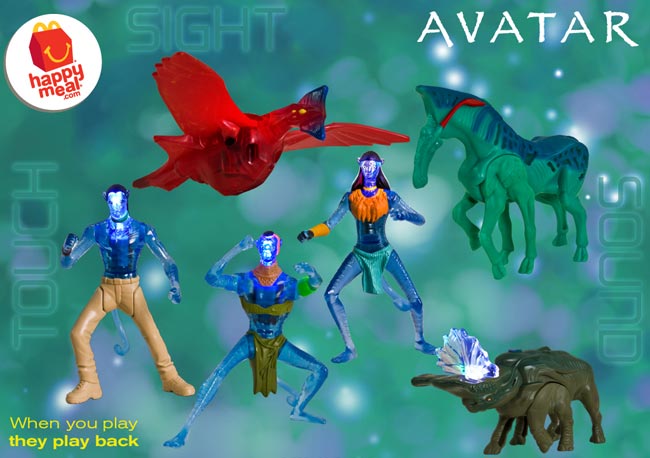
This marketing campaign crucially helped to connect online advertising with in-store purchases. For example, interactive toys in Happy Meals and AR ‘Thrill Cards’ with Big Macs, targeting the gaming demographic, that become part of the experience in the online Pandora when held up to a webcam.
A 3-D film, Avatar 'sets the bar high for customer engagement tie-ins,' McDonald's U.S. chief marketing officer Neal Golden said. But according to Cameron, the restaurant chain has delivered with its tech-heavy, futuristic look. "When I set out to write this movie, I knew that the [computer generated imagery] was about to create a situation where we could do anything that we could imagine," he said.
"McDonald's has stepped up and met that same level. I don't think anyone has seen anything like what they're doing with these tie-ins, the McD vision augmented reality in particular."
SOCIAL MEDIA
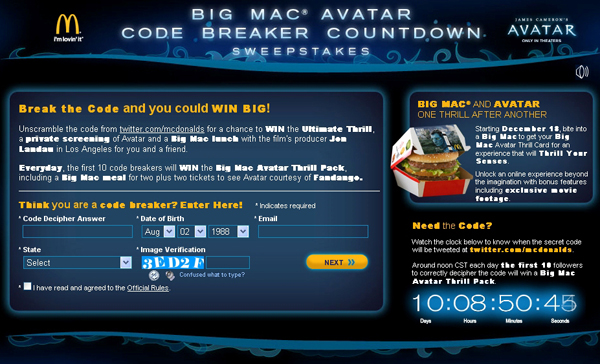
McDonald's also ran a Twitter campaign, asking followers to be the first 10 to decode daily word scrambles. The grand prize was a private screening of Avatar over a Big Mac lunch with producer Jon Landau (Source: Promo Magazine.)
Stats released the week beginning Monday 25th January 2010 showed that:
Total global receipts of the film had reached $1.858 Billion
This is $16 million ahead of the $1.842 Billion earned by Titanic, but Avatar hasn’t even finished yet.
Avatar has a shot at topping $750 million at the US box office and $2.5 billion worldwide.
Many people believe that the films huge earning were due to the global marketing campaign and social media proliferation.
In addition to this the 'Blogosphere' was inundated with posts about the film, trying to post spoilers, images, any and every tiny detail of information on the film shrouded in secrecy and enigma to the extent that many knew of the film the previous autumn! (That is one hell of a buzz!)
If that wasn't enough the Avatar YouTube page drew in millions of fans in their drones, loaded with behind the scenes information and fake videos by the character Dr Augustine.
The technologies that have been introduced and have grown in popularity over the past few years have helped market both films to their target audiences. iPhones and iPod touches have become massively popular in recent years, along with Apple's domination over the market. This proliferation has allowed almost anyone to create and app and put it on iTunes for users to download, either for free or a small price, and the marketers of both TBTR and Avatar have utilised this system to help get awareness of their films out there and available to a mass market. These apps are examples of technological convergence, and both allow complete portability and interactivity with the user.
The Boat That Rocked
Free iPhone/iPod Touch app
Official Top Trumps game with 1 or 2-player mode
High quality movie trailer, a good use of cross-media convergence to promote the film, as people download the app for the game and also get the advertisements for the film itself.
Movie image gallery
Created by Universal Pictures, the film's distributor which allowed a higher budget and reach of the app due to its large ownership spread
Developed by Golden Gekko on behalf of Hyper This app may not have been as successful as intended, as the film's core audience of over 60s aren't as likely to own iPhones or iPod touches so a large segment of their demographic will be missing out on this particular marketing strategy.
Avatar
2 Versions: Avatar (full version) currently at £2.99, Avatar Lite for Free
You play a Na'vi character fighting off undesired species who are destroying Pandora
It begins with a prequel story and showcasing the events leading up to the movie Avatar
Satisfies the users' needs and wants to be entertained and immersed in the world of Avatar
Use the key concepts to explore this further and draw conclusions
Interestingly, when directed to the official The Boat That Rocked website from an article about it, we were faced with this message:
This suggests that either they never created an official website, or it has now been deleted due to unpopularity or lack of updates. If a website was never created, Working Title really missed a marketing opportunity there, especially when targeting the teenagers and young adults of the Web 2.0 generation who are online constantly. They may have decided not to create a website due to its core target audience being those who were alive in the 1960s who don't seem to consume online media as much, but as we have identified the younger market is the secondary target audience for TBTR so they definitely could have got more publicity with that age range with a proper website.
The did, however, create this webpage for the US release of Pirate Radio:
This would not have helped target UK audiences though, as it would only have been set up months later when the film was released in the US, and the title would have been unfamiliar. The page was part of the official Focus Features website, Universal's US distributor, so it didn't even have a stand-alone website. A proper website would have been a good example of synergy between the film and online mediums, and a great way for Universal to harness the recent proliferation in online hardware and content.
We found a really interesting article on the Brand Republic website about a potential marketing strategy for TBTR:
The tourism body said it was in the process of tying up a partnership deal with Universal Pictures. VisitBritain is believed to be looking at a promotion based on the film, offering holidays in the UK as a prize.
Additionally the promotion is also run likely to run in the UK offering breaks in different parts of the country. It will launch prior to the fillm’s premiere on 3 April.
A spokeswoman for VisitBritain confirmed the tourism body was in discussions with Universal about linking in with the film but said no decision had been made on the execution.
The Boat that Rocked is based on 60s and 70s pirate radio stations such as Radio Caroline and attempts by Government to ban them. The film stars Rhys Ifans, Philip Seymour Hoffman and Bill Nighy.
According to industry reports VisitBritain is set to launch a new positioning campaign emphasising value offers in the UK such as free access to museums. The move follows a review from the government that found VisitBritain needed to work harder to coordinate British tourism policy.
Harnessing the films great soundtrack, The Boat that Rocked used the music medium Spotify to market the film, a great example of CROSS MEDIA CONVERGENCE and SYNERGY. Here's an interesting article by Aegis Media from April 2009:
The Boat That Rocked playlists on Spotify
This is a great illustration of how bands can use Spotify in their marketing. The Boat That Rocked, the new British film about pirate radio in the 1960s, has used Spotify to create playlists for each of the 9 DJs featured in the film. For example Dave, played by Nick Frost, has tracks from The Who, spencer Davis Group, The Kinks, The Troggs, and others.
Just go to the site, select a DJ, see their playist, and then click on one link to add it to your playlists on Spofity.
I'm really impressed by how well this works - it just takes one click and you've got the playlist.
The Boat That Rocks has also got a soundtrack album, and some of the DJs have playlists to buy on iTunes, but for my money this is the best use of music in promoting the film.
This is a great example of synergy between online media, music and the film itself. In 2009 it was revealed that in the UK, Spotify was more popular with the 50+ audience than teenagers, so the Spotify playlist may have been a step in the right direction to marketing towards the film's core audience of those who were alive in the 1960s. If the Spotify playlist had been advertised more so that these users were aware of it, this could have been a more successful marketing strategy than it was. The playlist could also have evoked feelings of nostalgia for the 1960s which would have encouraged listeners to go and see the film and enjoy these feelings even more, satisfying the audience's needs for escapism and development of personal identity. Spotify is currently only available in certain European countries, including the UK, which targets the UK audience specifically as it is not currently available in the US. This allowed the playlist to be adapted to the particular tastes and consumer habits of the British audience.
Really good evidence but you don't use the key concepts enough to pin down the issues and draw conclusions that could be used in the exam.