Showing posts with label jess w. Show all posts

Monday, 3 January 2011

Extra Corrections and Additional Information

In Response to feedback:
  • According to the forum on The Boat That Rocked (Pirate Radio)'s IMDB page there were mixed opinions on the film. Generally, positives included the films soundtrack- although many were annoyed by the absence of The Beatles, a typically iconic 60's British band (due to the fact that Universal did not own the rights to use their music on the soundtrack- Michael Jackson once owned their publishing catalog, but sold large parts of it to Sony to finance his later career and lifestyle. EMI and Apple Corps own nearly all their recordings.) It could have further helped the marketing campaign if the Beatles music was used because of its exclusivity and extreme popularity GLOBALLY, adding to the film's national and international appeal. 

  • Many Americans were angry at the title change, and found it patronising and insulting that Focus Features felt the need to 'dumb it down' for an American audience. This is a popular opinion amongst many online forum users and some movie critics. http://www.imdb.com/title/tt1131729/board/nest/149471627?p=1

  • United International Pictures (jointly owned by Universal and Paramount) distributed it and marketed it in the UK whereas Focus Features did it in the US. Though they appear to be seperate companies UIP is a global horizontally integrated media conglomerate and Focus Features is actually just an art house division of Universal Pictures. The decision to distribute it through them in America would have marketed the film as a more arty, indie film, attracting a more selective niche audience than the UK. This decision may not have been the right one as it is normally UK audiences that prefer the smaller, more art house films, whereas US audiences tend to prefer big high concept films which you would often associate with large distribution companies such as Universal. 
  • TBTR had a marketing budget of around $30 million, which is actually quite a large amount, although of course nothing compared to Avatar's $200 million plus. This would have greatly impacted on their marketing schemes as they would not have been able to afford as many TV spots etc. and invest in riskier newer, high concept online viral campaigns like AVTR.com- which actually proved pretty unsuccessful due to lack of maintenance and updates because they could afford to develop multiple strategies such as symbiotic campaigns with huge businesses like McDonald's and Coca Cola. Had UIP put all their money into one big risky branch of, for example online or viral marketing, it would have had no choice BUT to be successful as they did not have the luxury to fallback on any of the other marketing strategies due to a limited budget. Their decision to 'play it safe' and produce a tried and tested traditional campaign may have been the less, in business terms, riskier option. However, a cutting edge campaign could have potentially drawn in larger audiences and contributed to a higher gross at the box office. On the other hand it could have completely flopped and the film could have been seen by even fewer people than it was. Ultimately, it was a risk UIP was not willing to take, which is understandable because no-one is able to predict the outcome of a film's success before it is released- only speculate. 

Thursday, 9 December 2010

The Trailers

Avatar - Teaser Trailer


  • Released end of August, months before the film's release to create even more excitement and hype about it.
  • Only one line of dialogue - International appeal, nothing gets lost in translation. Emphasis on the visuals, the beauty of it and the amazing graphics. Understated, minimalistic orchestreal music.
  • Doesn't give anything about the plot away - Intriguing. Most people will already have heard of the film, so this is just to whet audience's appetites. A very good example of what a "Teaser" trailer is for.
  • Most shots are short clips, featuring camera movement to show scenery or characters, dissolves or fade-to-black between each shot. Not choppy or fast-paced, more slow-moving at the beginning. Towards the end of the trailer the transitions get faster and the tense atmosphere builds, more shots of the action-packed, exciting scenes.


Avatar - Official International Launch Trailer


The Boat That Rocked - Teaser Trailer

  •  'From Richard Curtis, creator of Notting Hill, Four Weddings and a Funeral and Love Actually'
  • Short clip of each famous actor, then their name 
  • Martha & The Vandellas - Dancing in the Street, 1964


American Trailer


  • 'Until one American DJ' - Completely re-telling the story to appeal to American audience
  • American voiceover
  • 'Academy Award winner Philip Seymour Hoffman'

iPod/iPhone Apps

The technologies that have been introduced and have grown in popularity over the past few years have helped market both films to their target audiences. iPhones and iPod touches have become massively popular in recent years, along with Apple's domination over the market. This proliferation has allowed almost anyone to create and app and put it on iTunes for users to download, either for free or a small price, and the marketers of both TBTR and Avatar have utilised this system to help get awareness of their films out there and available to a mass market. These apps are examples of technological convergence, and both allow complete portability and interactivity with the user.

The Boat That Rocked


  • Free iPhone/iPod Touch app
  • Official Top Trumps game with 1 or 2-player mode
  • High quality movie trailer, a good use of cross-media convergence to promote the film, as people download the app for the game and also get the advertisements for the film itself.
  • Movie image gallery
  • Created by Universal Pictures, the film's distributor which allowed a higher budget and reach of the app due to its large ownership spread
  • Developed by Golden Gekko on behalf of Hyper
    This app may not have been as successful as intended, as the film's core audience of over 60s aren't as likely to own iPhones or iPod touches so a large segment of their demographic will be missing out on this particular marketing strategy.


Avatar


  • 2 Versions: Avatar (full version) currently at £2.99, Avatar Lite for Free
  • You play a Na'vi character fighting off undesired species who are destroying Pandora
  • It begins with a prequel story and showcasing the events leading up to the movie Avatar
  • Satisfies the users' needs and wants to be entertained and immersed in the world of Avatar
    Use the key concepts to explore this further and draw conclusions


    The Boat That Rocked - Global and Online Campaign

    Official Website 


    Interestingly, when directed to the official The Boat That Rocked website from an article about it, we were faced with this message:


    This suggests that either they never created an official website, or it has now been deleted due to unpopularity or lack of updates.
    If a website was never created, Working Title really missed a marketing opportunity there, especially when targeting the teenagers and young adults of the Web 2.0 generation who are online constantly. They may have decided not to create a website due to its core target audience being those who were alive in the 1960s who don't seem to consume online media as much, but as we have identified the younger market is the secondary target audience for TBTR so they definitely could have got more publicity with that age range with a proper website.


    The did, however, create this webpage for the US release of Pirate Radio:

    This would not have helped target UK audiences though, as it would only have been set up months later when the film was released in the US, and the title would have been unfamiliar. The page was part of the official Focus Features website, Universal's US distributor, so it didn't even have a stand-alone website. A proper website would have been a good example of synergy between the film and online mediums, and a great way for Universal to harness the recent proliferation in online hardware and content.


    We found a really interesting article on the Brand Republic website about a potential marketing strategy for TBTR: 


    The tourism body said it was in the process of tying up a partnership deal with Universal Pictures. VisitBritain is believed to be looking at a promotion based on the film, offering holidays in the UK as a prize.

    Additionally the promotion is also run likely to run in the UK offering breaks in different parts of the country. It will launch prior to the fillm’s premiere on 3 April.
    A spokeswoman for VisitBritain confirmed the tourism body was in discussions with Universal about linking in with the film but said no decision had been made on the execution. 
    The Boat that Rocked is based on 60s and 70s pirate radio stations such as Radio Caroline and attempts by Government to ban them. The film stars Rhys Ifans, Philip Seymour Hoffman and Bill Nighy.
    According to industry reports VisitBritain is set to launch a new positioning campaign emphasising value offers in the UK such as free access to museums. The move follows a review from the government that found VisitBritain needed to work harder to coordinate British tourism policy.


    Full article here


    Harnessing the films great soundtrack, The Boat that Rocked used the music medium Spotify to market the film, a great example of CROSS MEDIA CONVERGENCE and SYNERGY. Here's an interesting article by Aegis Media from April 2009:


    The Boat That Rocked playlists on Spotify


    This is a great illustration of how bands can use Spotify in their marketing. The Boat That Rocked, the new British film about pirate radio in the 1960s, has used Spotify to create playlists for each of the 9 DJs featured in the film. For example Dave, played by Nick Frost, has tracks from The Who, spencer Davis Group, The Kinks, The Troggs, and others.


    Just go to the site, select a DJ, see their playist, and then click on one link to add it to your playlists on Spofity.


    I'm really impressed by how well this works - it just takes one click and you've got the playlist.


    The Boat That Rocks has also got a soundtrack album, and some of the DJs have playlists to buy on iTunes, but for my money this is the best use of music in promoting the film.
    This is a great example of synergy between online media, music and the film itself. In 2009 it was revealed that in the UK, Spotify was more popular with the 50+ audience than teenagers, so the Spotify playlist may have been a step in the right direction to marketing towards the film's core audience of those who were alive in the 1960s. If the Spotify playlist had been advertised more so that these users were aware of it, this could have been a more successful marketing strategy than it was. The playlist could also have evoked feelings of nostalgia for the 1960s which would have encouraged listeners to go and see the film and enjoy these feelings even more, satisfying the audience's needs for escapism and development of personal identity.
    Spotify is currently only available in certain European countries, including the UK, which targets the UK audience specifically as it is not currently available in the US. This allowed the playlist to be adapted to the particular tastes and consumer habits of the British audience.


    Really good evidence but you don't use the key concepts enough to pin down the issues and draw conclusions that could be used in the exam.

    The Posters

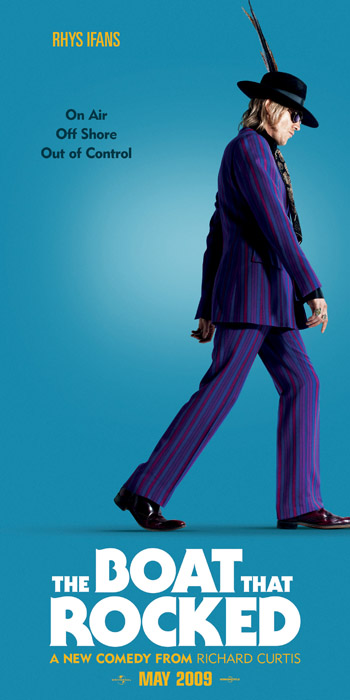
    The Boat That Rocked

    Teaser Posters

    Quad Poster


    Character Posters Set One


    Character Posters Set Two


    Main Campaign Poster


    American Poster


    Avatar


    Teaser Posters

    
    Released early August 2009


    First photo of the film released on August 14, 2009


    Empire magazine released exclusive images from the film in October 09


    Main Campaign Posters